
Penal Law

Alexandre Lacroix · October 7, 2026 · 10 min read
A statement of offence (ticket) for running a red light, failing to stop at a stop sign, crossing a solid line, speeding or any other offence under the Highway Safety Code often results in demerit points being entered in your driving record. That outcome is not inevitable. Section 310 of the Highway Safety Code, which imposes a general obligation on every driver to obey road signs and signals, carries no demerit points. When the prosecution’s evidence has weaknesses, a defence lawyer can negotiate a guilty plea to this general offence instead of the specific offence charged. The Gagné and Lebrun decisions confirm that this mechanism is valid. Me Alexandre Lacroix can negotiate your ticket with the prosecutor and represent you.
Section 310
The Highway Safety Code contains two types of provisions dealing with road signs and signals. On the one hand, it sets out specific offences aimed at a particular sign or signal: the stop sign (section 368), the red light (section 359), the speed limit (sections 299, 328 and 329) or the solid lane-dividing line (section 326.1). On the other hand, it sets out a general obligation, stated in a single sentence in section 310:
310. Every person is required to comply with the road signs and signals installed under this Code. [Our translation]
The difference between these two types of offences is not merely one of wording. The Regulation respecting demerit points assigns a number of points to each of the specific offences, but none to the general offence in section 310. In other words, a driver convicted of failing to stop at a stop sign has three points entered in their record, whereas a driver convicted of failing to comply with road signs, for exactly the same conduct, receives none.
The Lebrun decision: section 310 can apply to a situation covered by a specific offence
In Longueuil (Ville de) v. Lebrun, 2010 QCCS 5, a driver had received a ticket under section 310 for failing to comply with a 30 km/h speed limit. The Longueuil Municipal Court judge acquitted him after raising the issue on his own initiative: in his view, police officers could not charge a general offence where a specific provision, in this case section 328, applied to the situation (paras. 13 and 14).
Justice Sophie Bourque of the Superior Court rejected that reasoning. She pointed out that the choice of the offence charged falls within police discretion, and that the existence of a specific provision does not prevent recourse to the general one:
[24] The discretion that police officers exercise in the course of their work is broad. It covers, among other things, the decision to continue an investigation, the decision whether or not to lay charges, and the choice of the offence charged.
[…]
[26] The exercise of a discretionary power presupposes the possibility of a choice. In this case, such a choice exists between sections 310 and 328 et seq. H.S.C. [Our translation]
The judge adds that nothing in the Code supports the conclusion that the legislature intended to limit that choice:
[28] The mere fact that there are specific provisions on speed limits is not incompatible with the exercise of police discretion. [Our translation]
The lesson of Lebrun matters to anyone who receives a ticket: a conviction under section 310 is entirely valid, even when the facts alleged correspond to a more specific offence. The general offence is a real offence, placed in the Code by the legislature and recognized by the courts. Note that the City’s appeal was nonetheless dismissed on the merits, because the trial judge had believed the driver, who said he was driving at 30 km/h (paras. 40 and 41).
The Gagné decision: a guilty plea under section 310 accepted by the court
While Lebrun deals with the officer’s power to choose section 310 when issuing the ticket, Montréal (Ville de) v. Gagné, 2008 QCCM 288, deals with what can happen later, before the court. The defendant had received a ticket for crossing a single solid lane-dividing line, contrary to section 326.1. On the day of trial, his lawyer and the City’s prosecutor presented an agreement: the defendant would plead guilty to the general offence in section 310, and the parties jointly suggested a $200 fine (paras. 2 and 3).
Defence counsel explained why the prosecution had accepted this compromise:
[6] Finding it hard to understand why the Court would take this joint submission under advisement, counsel for the defendant reacted quickly, adding that his client had a good defence to raise and that, moreover, the prosecution’s evidence, which had not been filed, was hardly convincing. [Our translation]
The judge noted that his hesitation did not concern the fine, but the question of demerit points:
[7] The Court understands from what counsel imply that the proposed settlement is a compromise aimed at resolving an impasse. Indeed, the suggested fine, namely the maximum fine for an offence of this nature, remains the same if the plea is accepted. The offence of which the defendant would then be convicted does not, however, result in any demerit points being entered in the defendant’s record with the Société de l’assurance automobile du Québec, whereas a person convicted of the offence charged against the defendant has 3 demerit points entered in their record. [Our translation]
Judge Pelletier concluded that the rule in subsection 606(4) of the Criminal Code, which allows the court, with the prosecutor’s consent, to accept a guilty plea to another offence arising out of the same transaction, also applies in Quebec penal law (para. 44). He added that the judge must show deference to the prosecutor’s decision to accept such a plea, since the prosecutor is the one who knows their own evidence best:
[78] […] Perhaps the prosecution is able to establish the defendant’s guilt prima facie. Perhaps. But who other than the prosecution, that is, its counsel, is in the best position to know the strengths and weaknesses of its evidence at this stage? No one. [Our translation]
The Court therefore accepted the plea, convicted the defendant of contravening section 310, and acquitted him of the solid-line offence originally charged (paras. 94 to 96). The result: the same fine, but no demerit points.
A guilty plea under section 310, accepted by the prosecutor and the court, avoids the demerit points attached to the specific offence charged.
Concrete examples of demerit points avoided
The reasoning in Gagné and Lebrun can apply to any specific offence that penalizes failure to comply with a road sign or signal installed under the Code. The table below shows some common examples:
| Offence charged | Section of the Code | Demerit points |
|---|---|---|
| Failing to comply with road signs and signals | 310 | No points |
| Failing to stop at a stop sign | 368 | 3 points |
| Failing to stop at a red light | 359 | 3 points |
| Crossing a solid lane-dividing line | 326.1 | 3 points |
| Speeding by 21 to 30 km/h | 299, 328 or 329 | 2 points |
| Speeding by 31 to 39 km/h (excluding excessive speeding) | 299, 328 or 329 | 3 points |
For a probationary licence holder, whose revocation threshold is four points, the difference between three points and none can mean the difference between keeping one’s licence and losing it at the next offence. For every driver, demerit points remain on the record for two years and can affect automobile insurance premiums.
Two caveats apply. First, section 310 targets failure to comply with a sign or signal: it cannot replace an offence that does not rest on any sign or signal, such as using a cellphone while driving, the particulars of which are covered in our articles on cellphone use while driving and on the mistaken-object defence. Second, in cases of excessive speeding, the immediate licence suspension imposed by the officer at the time of the stop will apply automatically.
The key to negotiation: casting doubt on the prosecution’s evidence

The prosecutor is under no obligation to accept a plea under section 310. They will do so if they believe they risk losing the case at trial. As paragraph 6 of Gagné shows, it was the argument of a « good defence to raise » and evidence that was « hardly convincing » that led to the compromise. The lawyer’s role is therefore to analyze the evidence and demonstrate its weaknesses to the prosecutor, before the trial even begins.
Several factors can shake the prosecution’s confidence:
- The sign or signal itself: the stop sign, solid line or speed limit must be installed, visible and compliant at the exact location of the offence. A faded line, a sign hidden by vegetation or an ambiguous speed limit weakens the evidence.
- The officer’s observations: the distance, viewing angle, lighting, traffic density and the moment the officer actually saw the vehicle can be challenged in cross-examination.
- The speed measurement: the radar device must have been checked and properly used, and the pacing technique requires documented, constant distances and speed, as explained in our article on the pacing technique.
- The notes and offence report: notes that are incomplete, written after the fact or inconsistent with the ticket raise doubts about the reliability of the officer’s testimony.
- The legality of the stop: since the Luamba decision, a stop without grounds can be challenged and lead to the exclusion of evidence, as we explain in our article on police stops.
These arguments are put to the prosecutor using the disclosure of evidence, photographs of the scene and, where appropriate, the evidence the defence intends to present. Judge Pelletier also points out that such negotiated settlements are not a favour, but a necessity for the proper functioning of the courts:
[74] […] not only is the settlement of cases other than at the end of a trial on the merits not contrary to the public interest, it is a necessity. It is in the public interest. [Our translation]
The more uncertain the prosecution’s evidence, the more the prosecutor has to gain by accepting a plea under section 310 rather than risking an acquittal.
It is important to remain realistic, however: acceptance of this type of plea depends on the prosecutor and, ultimately, on the court. Judge Pelletier himself observed in 2008 that practice was not uniform from one municipal court to another (paras. 86 and 87). That is why it helps to retain a lawyer who knows the practices of the court where the ticket will be heard.
At the roadside: your right to silence
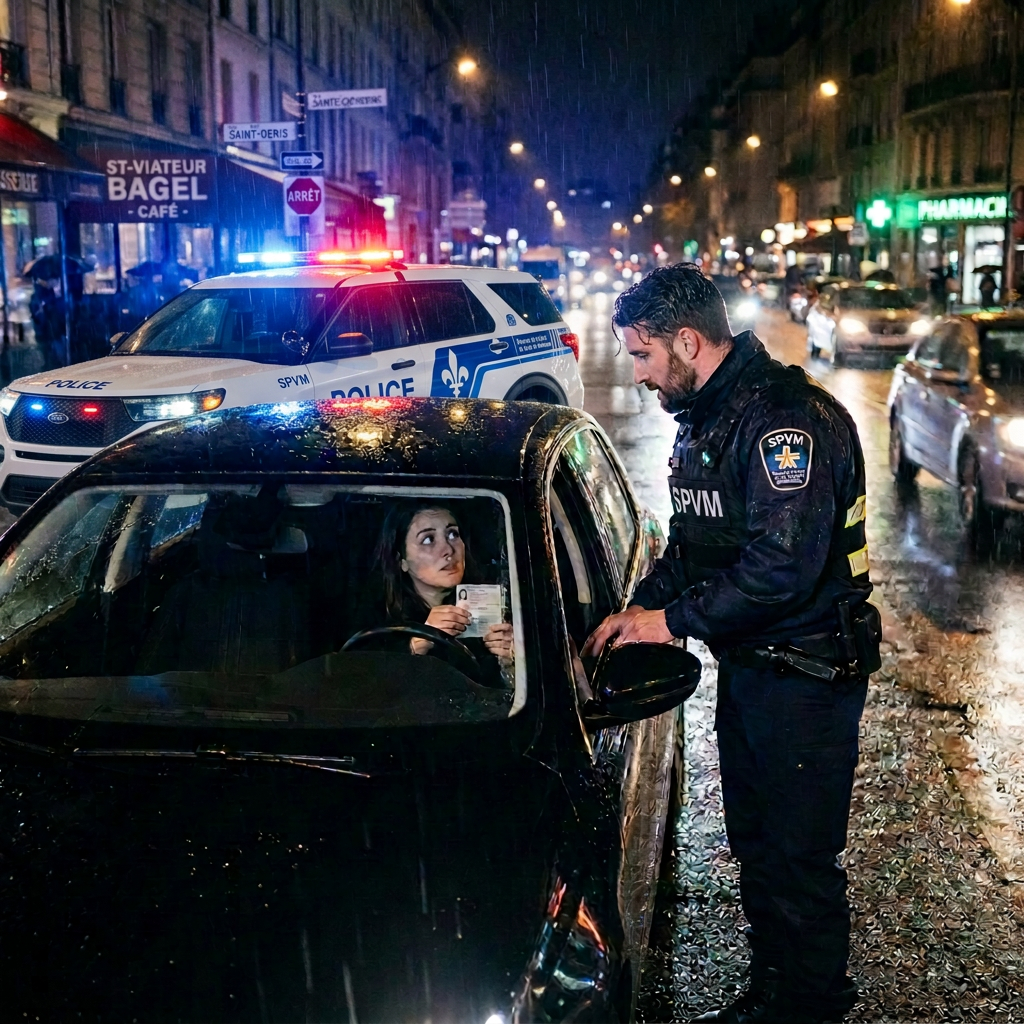
Many drivers try, at the roadside, to convince the officer to change the section written on the ticket or to « give them a break. » This strategy rarely works and can backfire. A driver who is stopped must identify themselves and hand over their driver’s licence, the vehicle registration certificate and proof of insurance, but is not required to answer the officer’s questions or comment on the facts. They have the right to remain silent.
Anything the driver says to the officer can be written down in the officer’s notebook and repeated at trial. A remark as harmless as « I didn’t see the sign » or « I thought the light was still yellow » can amount to an admission that strengthens the prosecution’s evidence and, at the same time, weakens the lawyer’s bargaining power. A driver who explains their version to the officer sometimes supplies the very element the evidence was missing.
It is therefore best to hand over the requested documents and say nothing more. As the Superior Court noted in Lebrun, the choice of offence belongs to the officer when the ticket is written (para. 24); once the ticket has been issued, the negotiation takes place with the prosecutor, not with the officer. Conducting that discussion is the lawyer’s role.
What to do after receiving a ticket
To keep every option open, including a plea under section 310, the driver should follow a few steps:
- Do not pay the fine: paying the fine amounts to a guilty plea to the specific offence charged and automatically results in the demerit points being entered. Once payment is made, there is nothing left to negotiate.
- Send a plea of not guilty within 30 days of service of the ticket, by completing the section provided for that purpose.
- Write down your recollection of the event promptly and photograph the scene and the signs, without discussing it with the officer.
- Consult a lawyer, who will request disclosure of the evidence, analyze it and open discussions with the prosecutor with a view to a plea under section 310.
A free information session with Me Alexandre Lacroix
A ticket is about more than a fine: the demerit points that come with it can lead to the revocation of your driver’s licence. The Gagné and Lebrun decisions show that a guilty plea under section 310 of the Highway Safety Code can, in many cases, resolve the matter without any demerit points, provided the prosecutor is convinced that their evidence is not beyond reasonable doubt. Me Alexandre Lacroix offers a free, no-obligation information session to analyze your ticket, assess the strength of the prosecution’s evidence and negotiate the best possible outcome on your behalf.
This blog post is provided for general informational purposes only and does not constitute legal advice. Every situation is unique — consult a legal professional for advice tailored to your case.
 Excessive Speeding: The Major Speeding Offence
 Speeding: The Pacing Technique
 Police Stops and Section 636 of the Highway Safety Code
Laisser un commentaire